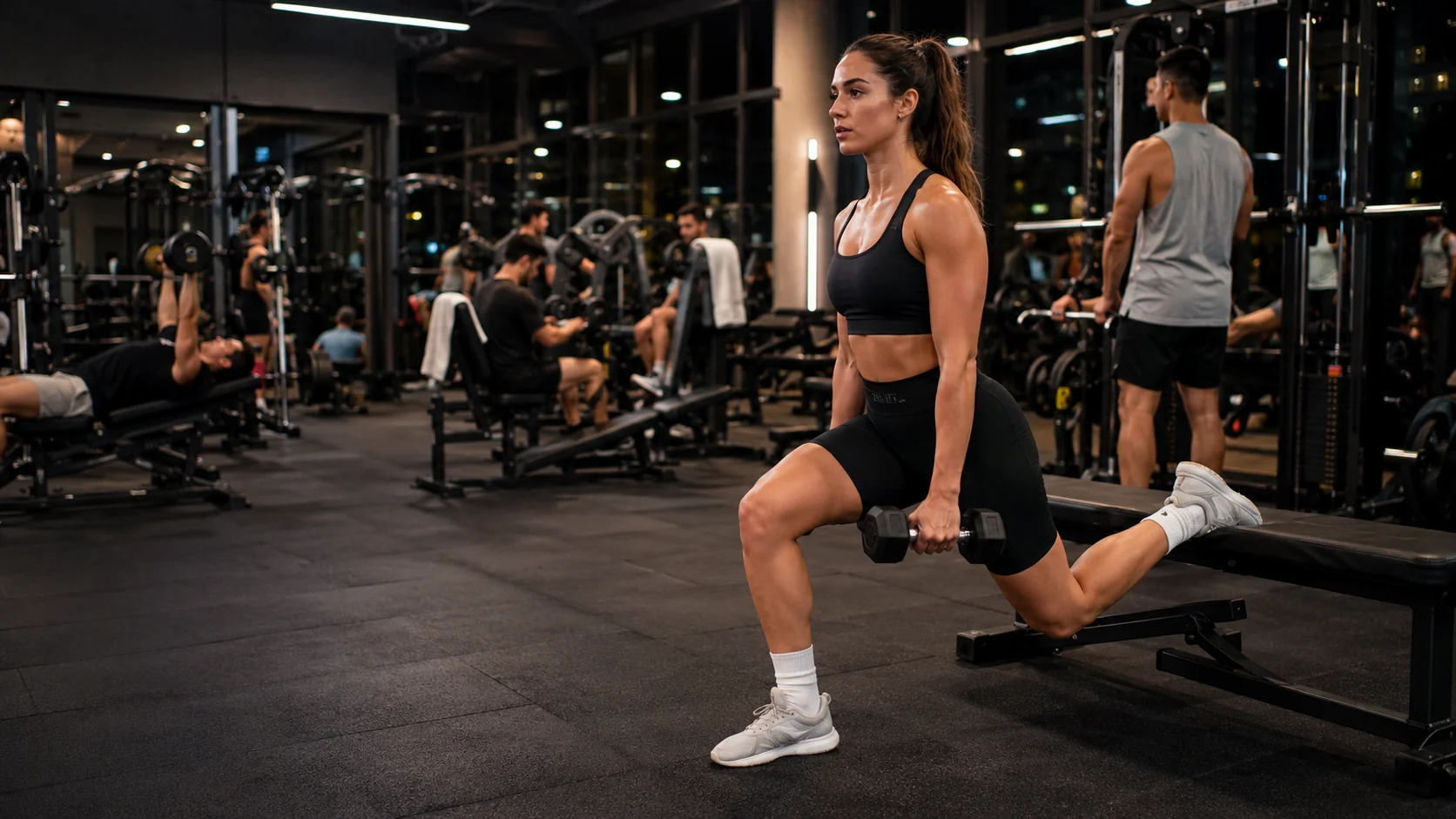
When gym equipment is busy, do not default to wandering, waiting indefinitely, or replacing a planned lift with a random exercise. Decide whether to wait, reorder, or substitute based on the workout’s priority and the kind of training stimulus you need. Then log the exercise you actually performed so your history remains useful.
The aim is not to recreate a barbell, machine, or cable perfectly. It is to preserve the important parts of the session: movement pattern, target muscles, effort, range of motion, and progression context.
The 60-Second Decision
| If this is true… | Best move | Why |
|---|---|---|
| The equipment is for your priority strength lift and should open soon | Wait or perform non-fatiguing preparation nearby | Exercise-specific practice and clean performance data matter |
| A compatible non-competing exercise is free | Reorder the workout | You keep the planned exercise without wasting time |
| The exercise is accessory work or the wait is open-ended | Use a planned substitution | A similar movement can preserve useful volume |
| The alternative changes the lift substantially | Log it as a different exercise | It is not a fair comparison with the original history |
| The gym is crowded enough that a superset needs two distant stations | Use straight sets or a single-station pair | Do not reserve equipment you cannot actively use |
The busy-gym solution should improve the session, not create a new problem for another lifter.
Start With the Exercise’s Job, Not Its Name
“Bench press” can mean several things: competition-style barbell practice, a heavy horizontal press, chest and triceps volume, or simply the first movement in your push day. The best substitute depends on which job matters today.
| Original exercise’s job | What must stay similar | What may change |
|---|---|---|
| Specific strength skill | Exact lift, setup, range, and loading | Very little; waiting is often better |
| Main compound movement | Movement pattern and hard effort | Tool, grip, or small setup details |
| Hypertrophy accessory | Target muscle, controlled range, sufficient effort | Equipment and exact angle |
| Rehabilitation or coached technical work | Prescribed movement and constraints | Do not improvise without guidance |
Both machines and free weights can build strength and muscle, but strength tests tend to favor the mode trained. Heidel et al., 2022
Wait, Reorder, or Substitute?
Wait when the lift is the point of the day
Waiting is reasonable for a high-priority squat, bench, deadlift, Olympic-lift variation, or technical movement. Use the time for warm-up, mobility, or a non-competing accessory.
Do not turn the wait into hard fatigue for the same muscles. Heavy dumbbell presses before a planned barbell bench press may solve boredom but can spoil the priority lift.
Reorder when you can preserve the exercise
Reorder if another planned exercise is free and will not compromise the priority movement. Do calves, rear delts, or a light row while the leg press is occupied.
Exercise order changes repeated-set performance; put the most important work first whenever practical. Simão et al., 2012
Substitute when the session’s intent matters more than the exact tool
Choose a substitution when the wait is uncertain, the original exercise is accessory work, or your schedule has a real time limit. A substitute should be close enough to preserve the training goal, but honest enough that you do not pretend it was the original exercise.
The Five Checks for a Good Exercise Substitution
Before making a swap, run through these checks.
| Check | Ask yourself | Example |
|---|---|---|
| Movement pattern | Is it still a press, row, squat, hinge, or curl? | Horizontal press → machine chest press |
| Primary target | Are the intended muscles still doing the main work? | Cable row → chest-supported dumbbell row |
| Stability and skill | Does the replacement demand much more or less balance? | Barbell squat → leg press changes the skill task |
| Loading and rep range | Can you train at the planned effort and range? | Dumbbells may suit 8–15 reps better than a heavy barbell target |
| Progression history | Can you track the alternative as its own movement? | Log dumbbell bench, not “barbell bench” |
A good swap can maintain the session’s purpose without being an identical performance test. Exercise variation may affect strength and hypertrophy outcomes, which is a reason to vary deliberately and to retain a stable reference exercise when it matters. Kassiano et al., 2022
Practical Substitutions When Equipment Is Taken
These are starting points, not promises that every option is interchangeable. Use the version you can perform with stable technique and the intended effort.
| If this is busy | Reasonable alternative | What changes | Logging rule |
|---|---|---|---|
| Barbell bench press | Dumbbell bench press or machine chest press | Stability, path, and loading scale | Log as the actual variation |
| Squat rack | Hack squat, leg press, or goblet squat | Squat skill and trunk demand | Keep separate from barbell squat history |
| Cable row | Chest-supported dumbbell row or plate-loaded row | Resistance path and torso support | Compare only within the chosen variation |
| Lat pulldown | Assisted pull-up or a different pulldown station | Grip and body position | Note grip/attachment if relevant |
| Leg curl | Seated, lying, or standing leg-curl variation | Hip position and machine mechanics | Treat each as a distinct exercise if performance matters |
| Cable lateral raise | Dumbbell lateral raise or lateral-raise machine | Resistance curve | Preserve controlled range, not cable numbers |
| Pec-deck | Cable fly or dumbbell fly | Resistance curve and stability | Use conservative load while learning the new version |
For a deeper comparison of tools, see free weights vs. machines. The practical answer is often “use the tool that fits today’s goal and availability,” not “one tool is always superior.”
Do Not Let a Busy Gym Ruin Exercise Order
You can be flexible without turning a planned session upside down.
| Priority exercise | Good use of the waiting time | Usually a poor use of the waiting time |
|---|---|---|
| Heavy barbell bench press | Mobility, warm-up, rear-delts, easy calves | Hard dumbbell pressing or triceps failure work |
| Squat or deadlift | General warm-up, easy core work, light upper-body accessory | Hard leg press, lunges, or hamstring work |
| Cable row | A non-overlapping lower-body accessory | Fatiguing curls if biceps are already limiting your rows |
| Leg curl | Calves, light upper-body accessory, or a separate free station | Exhausting hinge work that makes the curl a different task |
The rule is simple: move a non-interfering exercise forward; do not pre-fatigue the movement you most care about. For a full framework, see what order should you do exercises in?.
Temporary Swap vs. Routine Edit
Treat a one-day busy-gym swap differently from a permanent change to your program.
A temporary swap
For a one-off availability issue, keep the routine intact, log the substitute as the real exercise, and add a brief note. Return to the original movement next time.
A routine edit
If the same bottleneck occurs every evening, edit the routine’s default movement to one you can perform consistently. Update the progression target too: a cable-row PR does not transfer to dumbbell rows.
How to Keep Exercise History Useful in Gymtrack
The fastest way to corrupt your progress history is to log a substitute under the original exercise name. If you use a machine chest press, recording it as barbell bench press makes the next “comparison” meaningless.
| What happened | How to record it | Why |
|---|---|---|
| One-off replacement | Add the substitute exercise and note why | Preserves original exercise history |
| Permanent availability issue | Edit the routine’s default exercise | Keeps future sessions executable |
| Same movement, different grip or machine | Record the variation consistently | Prevents false PRs and unclear trends |
| Reordered session | Log the actual order and rest | Explains performance changes |
| A cancelled exercise | Leave it out or mark it skipped—do not invent sets | Keeps volume and adherence accurate |
In Gymtrack, edit the current routine only when the change is likely to persist. For a one-time substitution, add the actual exercise, log its sets, reps, load, and RIR, then return to the original movement when it is available. Your exercise history stays interpretable, and workout tracking can still show meaningful progression.
A Busy-Gym Example: Keep the Session’s Purpose
Nina’s push-day priority is barbell bench press for 3 × 6–8. All benches are occupied, but dumbbells and a chest-press machine are free.
| Situation | Best choice |
|---|---|
| A bench should open soon | Light warm-up and wait; barbell bench is the priority skill |
| No timeline, with 35 minutes left | Use machine chest press for 3 × 8–12 and log it separately |
| Hard shoulders and triceps already done | Do not force a heavy bench test; choose a controlled substitute or move bench to next session |
This is not an inferior workout; it is a different, clearly recorded workout. Do not call the machine set a bench PR.
Crowded-Gym Etiquette That Also Improves Training
- Do not reserve two stations for a superset in a crowded gym.
- Ask politely whether you can work in rather than assuming a station is unavailable.
- If working in changes the load or rest unpredictably, log that context and avoid treating it as a benchmark session.
- Bring one or two backup options for every high-demand station before you arrive.
- Do not replace purposeful rest with random extra work just to look busy.
The last point matters: a rest period is part of the program, not empty time that needs to be filled.
Frequently Asked Questions
What should I do when gym equipment is busy?
Wait for a priority skill lift when the delay is brief; reorder non-competing work; substitute when the wait is open-ended or the movement is accessory work.
Is it okay to change exercises at the gym?
Yes, if the replacement matches the session’s purpose and you can perform it safely. Treat it as a different exercise in your log rather than pretending it produced the same data.
Should I wait for a machine or use free weights instead?
Wait if the machine is a priority or the delay is brief. Use free weights when they preserve the goal and waiting would damage the session; the reverse can also be true.
Can I superset exercises when the gym is crowded?
Only when the exercises are nearby, the equipment is available, and you are not monopolizing two stations. Otherwise, use straight sets or a one-station pairing.
How do I track substitutions in a workout app?
Log the substitute under its own name, with its own load, reps, RIR, and notes. Do not merge it with the history of the original exercise.
Will changing exercises hurt my progress?
Not automatically. One thoughtful substitution rarely derails a program, but changing a priority lift repeatedly makes progression harder to interpret.
The Bottom Line
Busy equipment does not require a chaotic workout. Identify the job of the original exercise, then choose to wait, reorder, or substitute based on priority, interference, and time.
Keep temporary substitutions separate in your log, edit the routine only when the availability problem is chronic, and carry on with a session you can actually perform. Flexibility is useful when it protects both progress and your workout history.
Evidence Notes
- Exercise order can affect repeated-set performance and should follow the priorities of the training goal where practical. Simão et al., 2012
- Free-weight and machine training can both build strength and muscle, but strength improvements tend to be more specific to the mode tested. Heidel et al., 2022
- Varying exercise selection may influence strength and hypertrophy outcomes; use variation deliberately rather than losing track of the movement you are progressing. Kassiano et al., 2022
Training note: Use a substitute only if you can perform it with appropriate technique and control. If you are returning from injury or have exercise-specific restrictions, follow individualized guidance rather than improvising a replacement.